

Steel, textiles, beads, pearls, feather fan
2014
Image courtesy of the artist.
Rina Banerjee, who was born in Kolkata, India, and lives in New York, works with a cosmopolitan eclecticism that reflects both her transnational background and her sophisticated understanding of the narrative power of objects. Using trinkets made for the tourist trade — horn, bone, feathers, shells, textiles, glass bottles, and antiques — she assembles rapturous sculptures that are mystifyingly shamanistic, yet overflowing with connotation. Her works are hyper-ornamented and lushly seductive. Conjoining rarities with cheap, mass-produced bric-a-brac, she appropriates extravagantly while rejecting hierarchies of material, culture, and value.
In Banerjee’s paintings and delicate drawings on paper, female figures float in chimerical landscapes, often in states of transformation or with hybrid features of birds and beasts. Her titles are long, free-form refrains that immerse the viewer in the physical and emotional space of the work, heightening its quasi-mystical magnetism.
In a 2011 feature in Artforum, Banerjee describes the foundations of her work:
 The world as burnt fruit – When empires feuded for populations and plantations, buried in colonial and ancient currency, a Gharial appeared from an inky melon – hot with blossom sprang forth to swallow the world not yet whole as burnt fruit
fans, feathers, cowrie shells, resin alligator skull, globe, glass vials, light bulbs, gourds, steel wire, Japanese mosquito nets
90″ x 253″ x90”
Installation view of Rina Banerjee: Make Me a Summary of the World at San José Museum of Art, May 16–October 6, 2019. Photo by J. Arnold, Impart Photography.
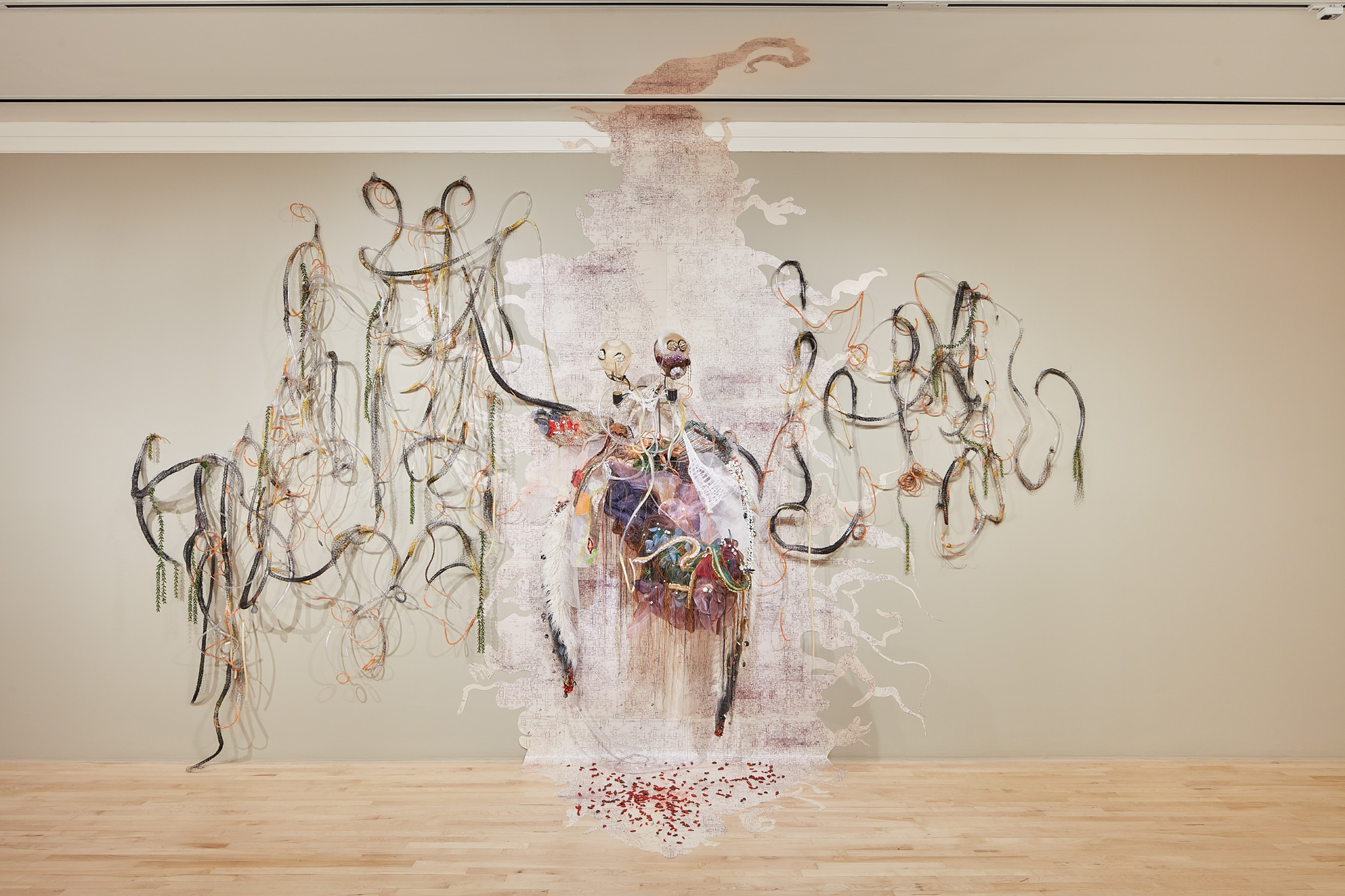
Kumkum, turmeric, Indian blouse gauze, fake fingernails and eyelashes, foam, feathers, fabric, Spanish moss, light bulbs, wax, quilting pins, plastic tubing, latex and rubber gloves, acrylic and dry pigment, cowrie shells, gourd, horn, urchins, silk, bone
Installation view of Rina Banerjee: Make Me a Summary of the World at San José Museum of Art, May 16–October 6, 2019. Photo by J. Arnold, Impart Photography.
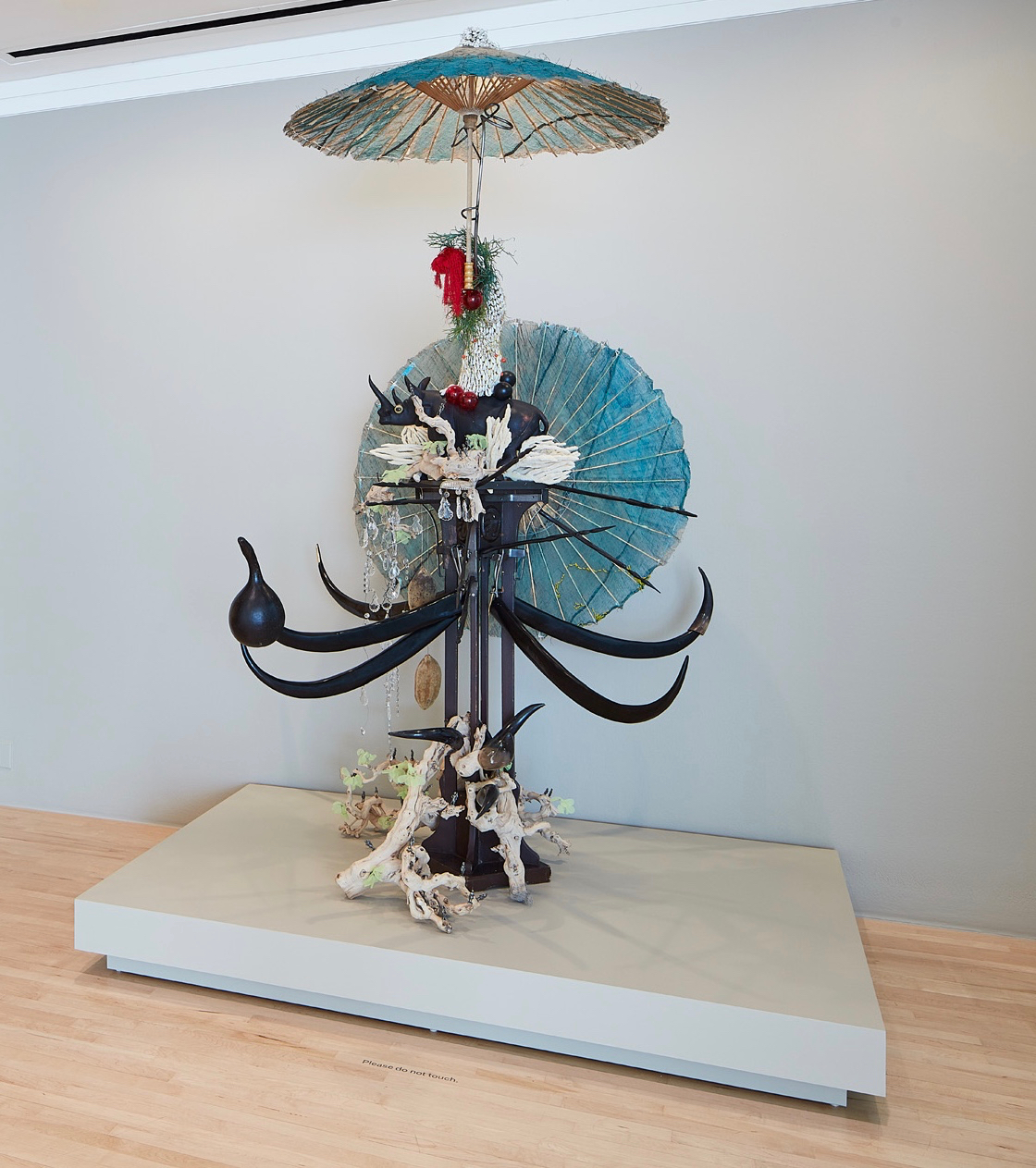
Wood rhino, Chinese umbrellas, sea sponges, linen, beads, pewter soldiers, grape vines, glass chandelier drops, acrylic horns, wire, nylon, and bead flowers, 7′ × 4′
Installation view of Rina Banerjee: Make Me a Summary of the World at San José Museum of Art, May 16–October 6, 2019. Photo by J. Arnold, Impart Photography.
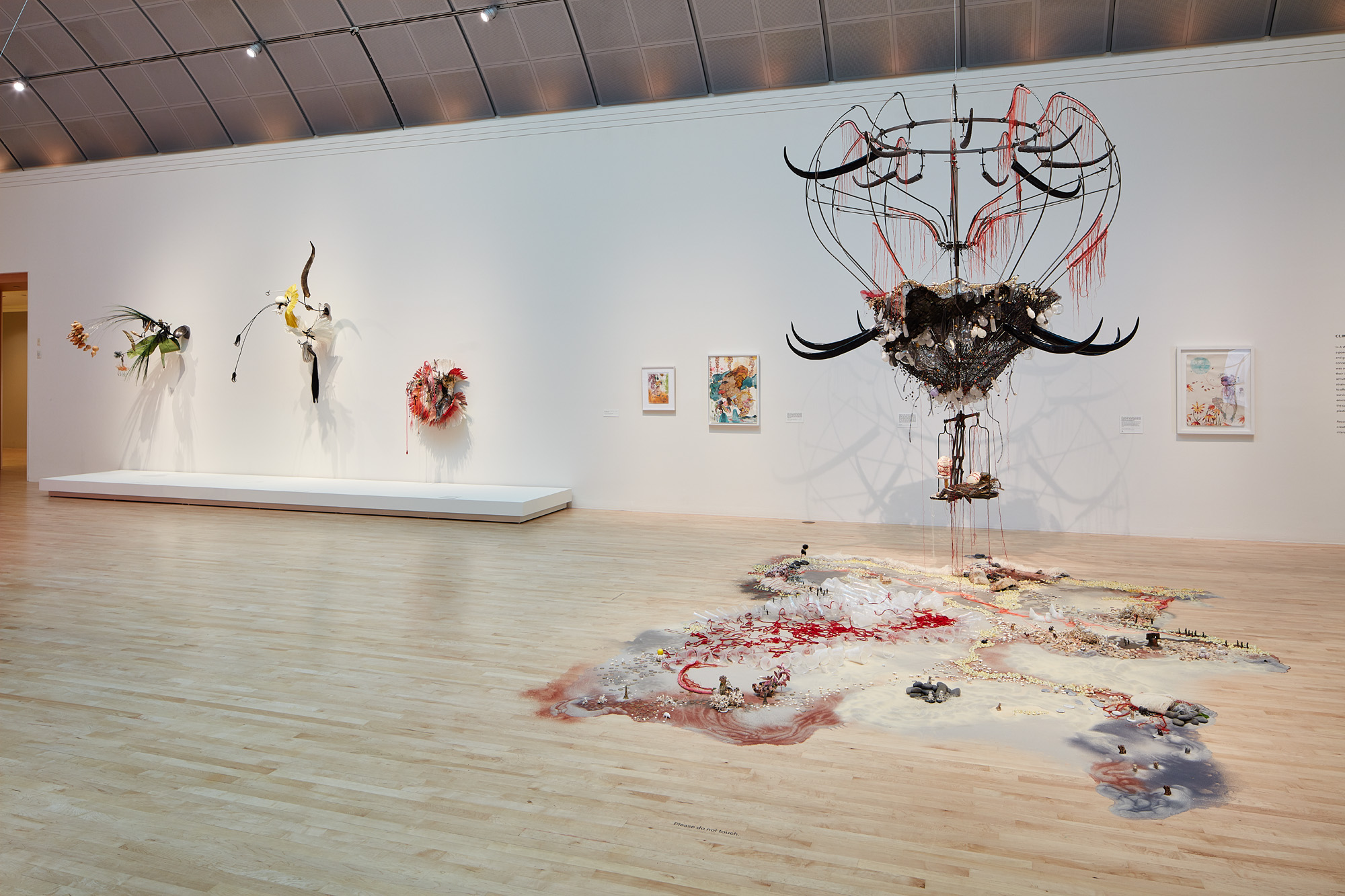
Black synthetic horns, wire, netting, lightbulbs, scale, ostrich eggs, textiles, cowrie shells, pebbles, coins, feathers, fish vertebrae, greenery, coral, glass birds, miniature human and animal figurines, plastic cups, and red thread,
132″ x 234″ x 128″, 2013
Installation view of Rina Banerjee: Make Me a Summary of the World at San José Museum of Art, May 16–October 6, 2019. Photo by J. Arnold, Impart Photography.
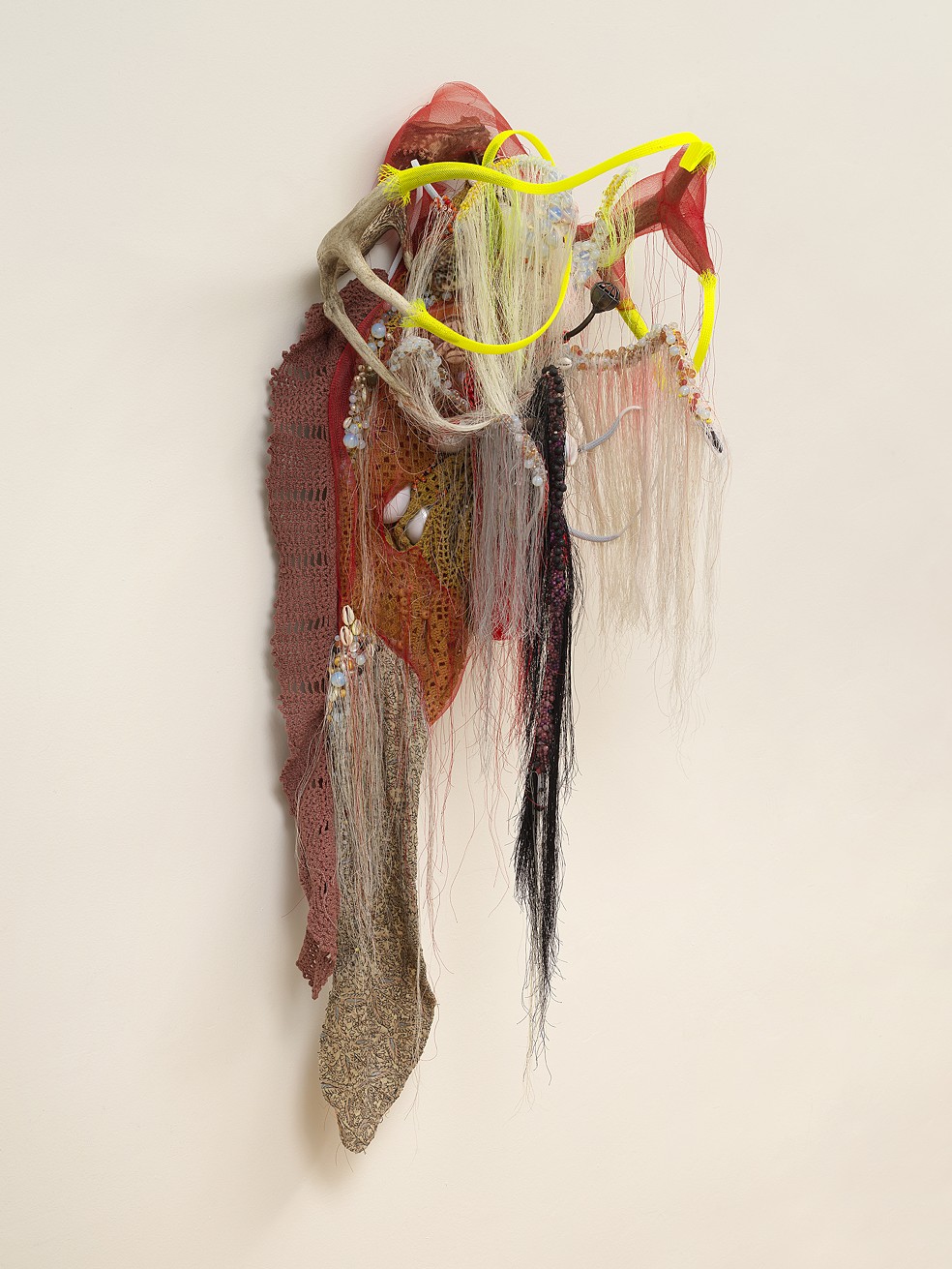
Beads, shells, fabric, metal, mirrors, plastic, thread
119,4 cm × 39,4 cm × 34,3 cm
Image courtesy of the artist.
mice was eaten by a world hungry for commerce made these into flower, disguised could be savoured alongside whitened rice
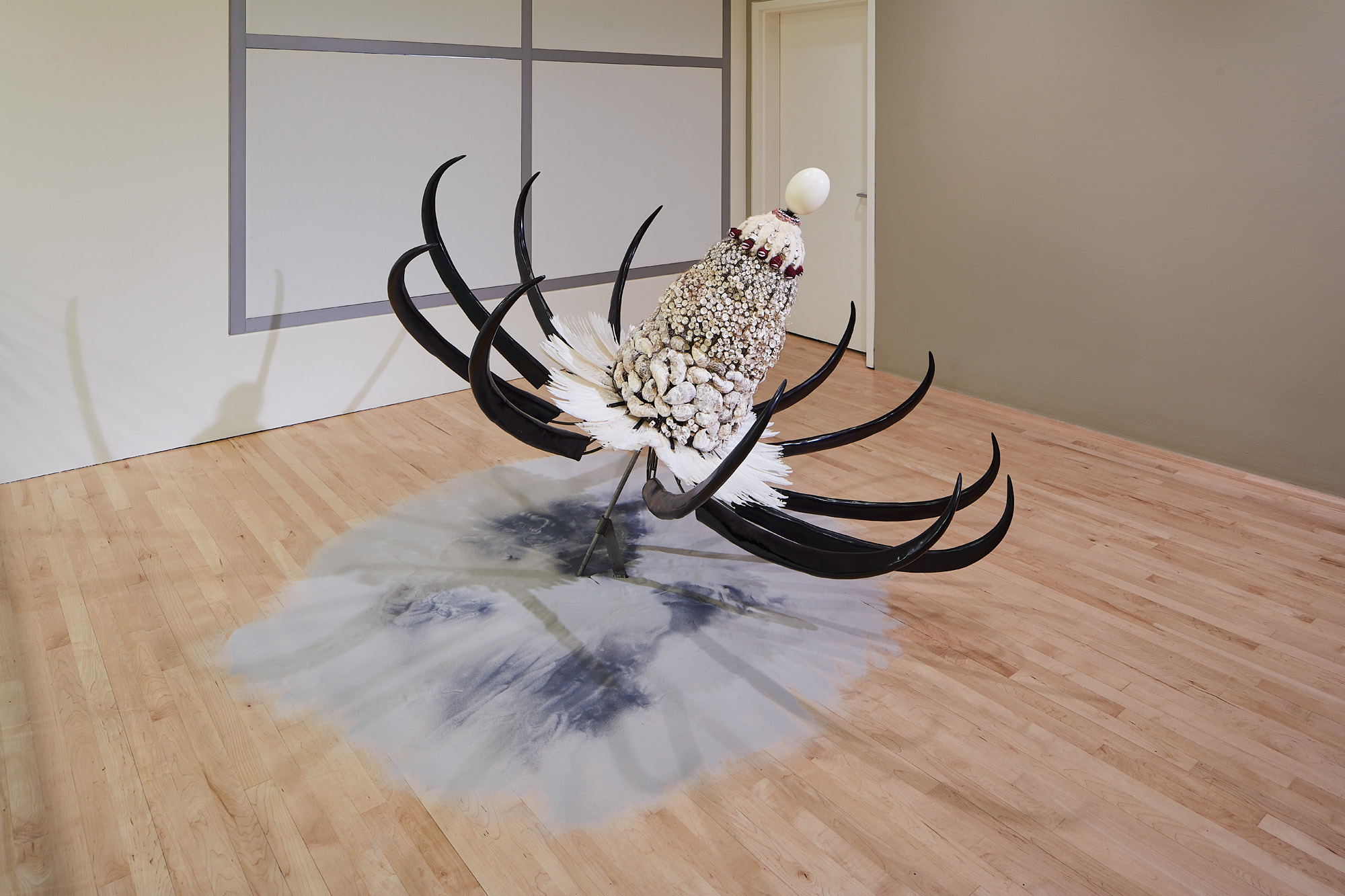
Oyster shells, fish bone, thread, cowrie shells, fur, deity eyes, copper trim, ostrich egg, epoxy American buffalo horns, steel, fabricated umbrella structure, steel stand, pigeon-feather fans, 21⅝ × 61 × 78⅜ in., 2009, Installation view Fowler Museum at UCLA
Installation view of Rina Banerjee: Make Me a Summary of the World at San José Museum of Art, May 16–October 6, 2019. Photo by J. Arnold, Impart Photography.

Incense sticks, Kumkum, vaseline, turmeric, Indian blouse gauze, fake fingernails and eyelashes, chalk, foam, feathers, fabric, Spanish moss, light bulbs, wax, Silly Putty, quilting pins, plastic tubing, latex and rubber gloves, acrylic and dry pigments, dimensions variable. Installation: The Whitney Biennial 2000, Whitney Museum of American Art, New York, 2000
Images courtesy of San José Museum of Art

Incense sticks, kumkum, vaseline, turmeric, Indian blouse gauze, fake fingernails and eyelashes, chalk, foam, feathers, fabric, Spanish moss, light bulbs, wax, Silly Putty, quilting pins, plastic tubing, clay, latex and rubber gloves, acrylic and dry pigment
Dimensions Variable
Courtesy of the artist and Perrotin Gallery
The production of the Contagious Migrations originally began in 2000 with an older iteration of the sculpture titled Infectious Migrations, which was part of the 2000 Whitney Biennial. Originally conceived in the aftermath of the AIDS crisis, the piece critiques the construction of a disease-ridden ‘other,’ and the intercorrelation of illness with systemic oppressions, such as homophobia, racism, and xenophobia.
The background of the piece is composed of found hand-drawn exhaust and ventilation maps from the Columbia University Center of Disease and Control from 1968, and points to another historical moment in which fear of disease was imbued with systemic oppression. 1968 was a year of a flu pandemic in the United States, which was caused by a flu strain derived from China and led to a surge of racism and violence toward East Asian peoples.
The piece is ripe with medical residue: plastic tubing, latex, and rubber gloves. The tubing underscores the phenomena of transmission, referencing both the transmission of medicines, as well as the global movement of people, goods, and disease via colonization, enslavement, immigration, or trade. The piece also contains elements of or associated with the human body, such as fake fingernails and eyelashes, highlighting the human beings impacted by both disease and persecution.
WEAD MAGAZINE ISSUE No. 14: KINSHIP: THE ART OF CONNECTION
© Copyright 2023 Women Eco Artists Dialog. All rights reserved.